Bitcoin is for Everyone -A Review
In which I discuss Natalie Brunell's book on Bitcoin
STABLECOINS
Stable Sis
12/2/20254 min read


Reading is possibly my favourite thing in the world. Which means I will periodically review books pertaining to StableCoins (few), DeFi (some) or cryptocurrencies (many).
The first nine chapters of this book were pure pleasure to read and, therefore, went down quickly. Natalie Brunell opened my eyes to something that, once you see it, you will ask yourself "How did I not ask myself this question before?".
The question is simple: "Whatever has happened to all the money that has been printed since the Great Financial Crisis?" Following from this premise, Ms Brunell takes us all the way back to the beginning of the financial system in the US, through the economic crises of the 70s and the end of Bretton Woods up until the Covid-years expansionary policy of the Fed and other major world banks.
This is a well researched and reasoned history and everyone will be better off for following along. The conclusion Ms Brunell is simple: "The US government has given itself a free pass to print as much money as it wants and has abused this right, so that there is so much money in circulation that money itself has lost its worth".
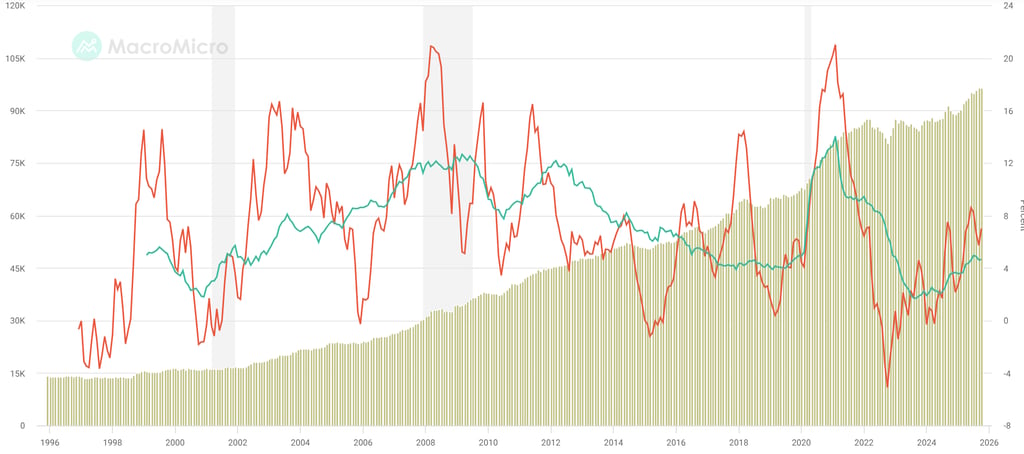
You may think she is exaggerating, but she has a point, as shown in the chart below:
Source: https://en.macromicro.me/charts/3439/major-bank-m2-comparsion
What you can see above is the money in circulation from the four major central banks (US, EU, Japan and China). From 1996 to 2006, less than 10T USD were added to the global economy, so the money in circulation went from 14.1T USD to 23.6T USD. However, from 2006 to 2016, the money in circulation went from 23.6T to 52.9T, a 124% increase. Then, from 2016 to now, another 44T have been added, so that now the money supply is a whopping 96.2T.
Let that sink in.
And so of course, by the law of very simple economics, since money is in such plentiful supply, its intrinsic value is a lot lower than it used to be. And so it takes more money to buy things. Therefore everything costs more. Wages however are a lot slower to adjust and so you end up in the unfortunate situation where things get more and more unaffordable.
As I said, this was the part of the book that I enjoyed. Unfortunately, as soon as we move on to actually talking about Bitcoin, Ms Brunell throws all her analytical rigour out of the window. She does not present any shortcoming or potential problem with Bitcoin and tells us over and over again with a zeal that is almost religious that whatever our problem may be, Bitcoin is the solution.
Ms Brunell only mentions in passing the potential for misusing Bitcoin for illicit activities and money laundering and one can read the between the lines that it is a price worth paying for the reward of anonymity. However, the quickest of Google searches brings up the following news:
1.5B USD laundered through bitcoin-mixing service Cryptomixer - December 2025
Ignoring these and many similar cases is akin to saying that there is no point in enforcing AML regulations in the traditional financial sector and as a former financial crime risk manager, I almost take a personal offence to this.
Then there is of course, Ms Brunell's remark on Michael Saylor and how in the future books would be written about his visionary strategy. Well, that comment did not age well (here is the analysis from the always enlightening folks at Alphaville).
However, the thing I disagree with the most is the premise that Bitcoin is not a fiat based currency, just like the US dollar, only because it takes electricity to mine it.
First, in a world of falling electricity prices, it will become increasingly cheaper to mine and therefore easier to get bitcoins. Those who will win from this are the same ones who are winning already and will keep on increasing their bitcoin treasure, just as it happens nowadays with traditional financial assets. The irony is that the accumulation of assets in the hands of the few is exactly what Ms Brunell is annoyed about.
Second, the total supply of bitcoins is capped 21M, with each bitcoin divided into 100M satoshis. This means that in total there are 2.1 quadrillion satoshis that at some point will be in circulation. This dwarfs the supply of money currently around and again, if falling electricity prices will make mining easier, the value of satoshis will be depressed just like US dollars.
Finally, and as the recent dramatic swings in Bitcoin prices show, what is holding up Bitcoin is nothing more than our collective agreement that it is indeed worth trading. Once that understanding evaporates, all you are left with is a digital address. That is the definition of fiat currency.
Now, of course, I am not saying Bitcoin is a bad thing, I run a stablecoin blog. And maybe I am not Ms Brunell's target audience, and her language of unmitigated praise is lost on me. All I know is that there is no miracle silver bullet for what ails our economy. I can see why it is tempting to embrace Bitcoin as the easy cure to our illness. It sounds easy and straightforward. Giving in to this magical thinking however is nothing more than denial. Fixing the global economy will require gaining again a firm hold on our monetary policy. And that will require hard work. And extremely difficult choices.
Until next time,
StableSis